Options for inclusive digital wallets
October 2026 update: the deck is restyled to the ID30 graphic charter and fully copy edited.
Verifiable credentials are easy to issue and verify with a smartphone, yet many people still have no device or network connectivity. This study, started in January 2023, reviews the contexts and constraints of applicants and the components of a solution, then proposes inclusive options for digital wallets: cloud wallets, smart cards, signed QR codes, secure storage and operator tablets.
Slide content
-
Options for inclusive Digital Wallets
Ideas for inclusive public attention
Decentralized forms of wallets
Jaume Dubois, January 2023, updated October 2026
-
Types of applications
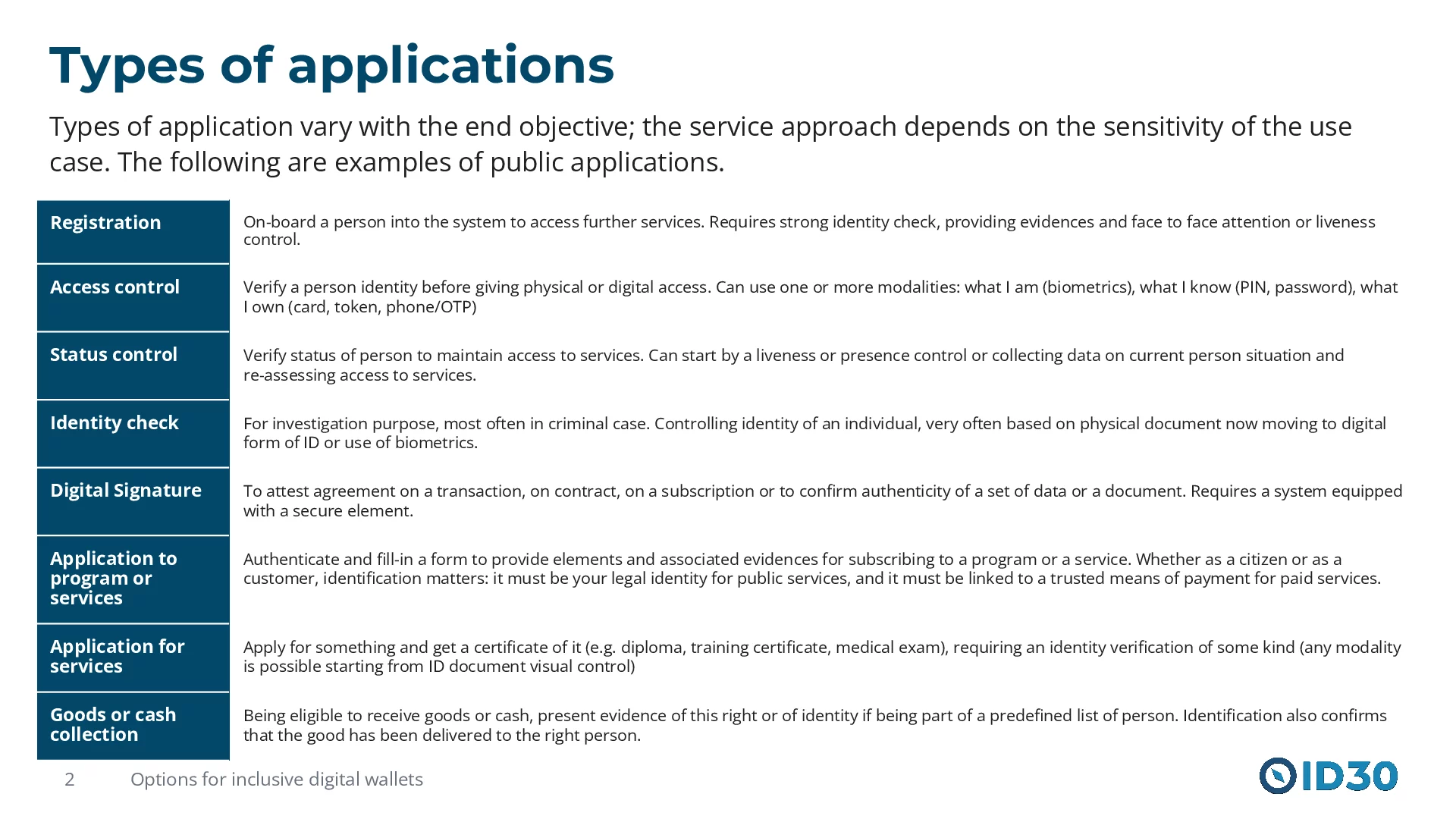
Types of application vary with the end objective; the service approach depends on the sensitivity of the use case. The following are examples of public applications.
Registration — On-board a person into the system to access further services. Requires strong identity check, providing evidences and face to face attention or liveness control.
Access control — Verify a person identity before giving physical or digital access. Can use one or more modalities: what I am (biometrics), what I know (PIN, password), what I own (card, token, phone/OTP)
Status control — Verify status of person to maintain access to services. Can start by a liveness or presence control or collecting data on current person situation and re-assessing access to services.
Identity check — For investigation purpose, most often in criminal case. Controlling identity of an individual, very often based on physical document now moving to digital form of ID or use of biometrics.
Digital Signature — To attest agreement on a transaction, on contract, on a subscription or to confirm authenticity of a set of data or a document. Requires a system equipped with a secure element.
Application to program or services — Authenticate and fill-in a form to provide elements and associated evidences for subscribing to a program or a service. Whether as a citizen or as a customer, identification matters: it must be your legal identity for public services, and it must be linked to a trusted means of payment for paid services.
Application for services — Apply for something and get a certificate of it (e.g. diploma, training certificate, medical exam), requiring an identity verification of some kind (any modality is possible starting from ID document visual control)
Goods or cash collection — Being eligible to receive goods or cash, present evidence of this right or of identity if being part of a predefined list of person. Identification also confirms that the good has been delivered to the right person.
-
Introduction
We consider verifiable credentials to be a future interoperable trusted dataset which will facilitate interactions in a trusted way.
They will be easy to issue and verify with a smartphone, but not everybody has access to such devices or to network connectivity.
The objective of this study is to figure out how to leverage them while limiting the exclusion of part of the population.
For this purpose, we have studied the different contexts together with the different constraints of applicants and concluded with possible options.
One outcome would be to bring in requirements so that digital wallets include more inclusive forms, another one would be to build a viable solution.
Thanks to MOSIP, DHI team and OpenWallet Foundation people for their time and insights around that topic.
-
Fill the digital gaps facing applicants
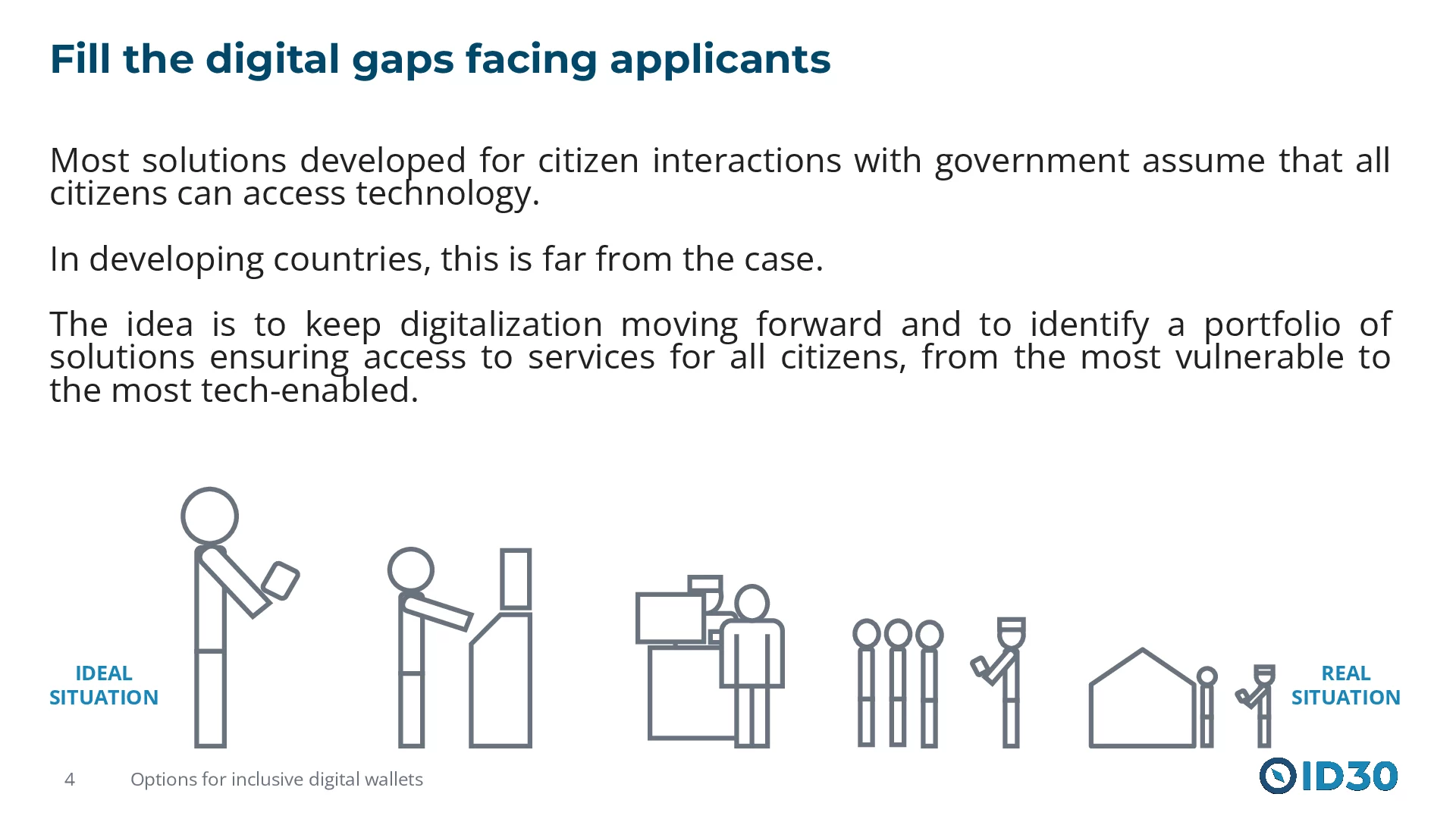
Most solutions developed for citizen interactions with government assume that all citizens can access technology.
In developing countries, this is far from the case.
The idea is to keep digitalization moving forward and to identify a portfolio of solutions ensuring access to services for all citizens, from the most vulnerable to the most tech-enabled.
IDEAL SITUATION
REAL SITUATION
-
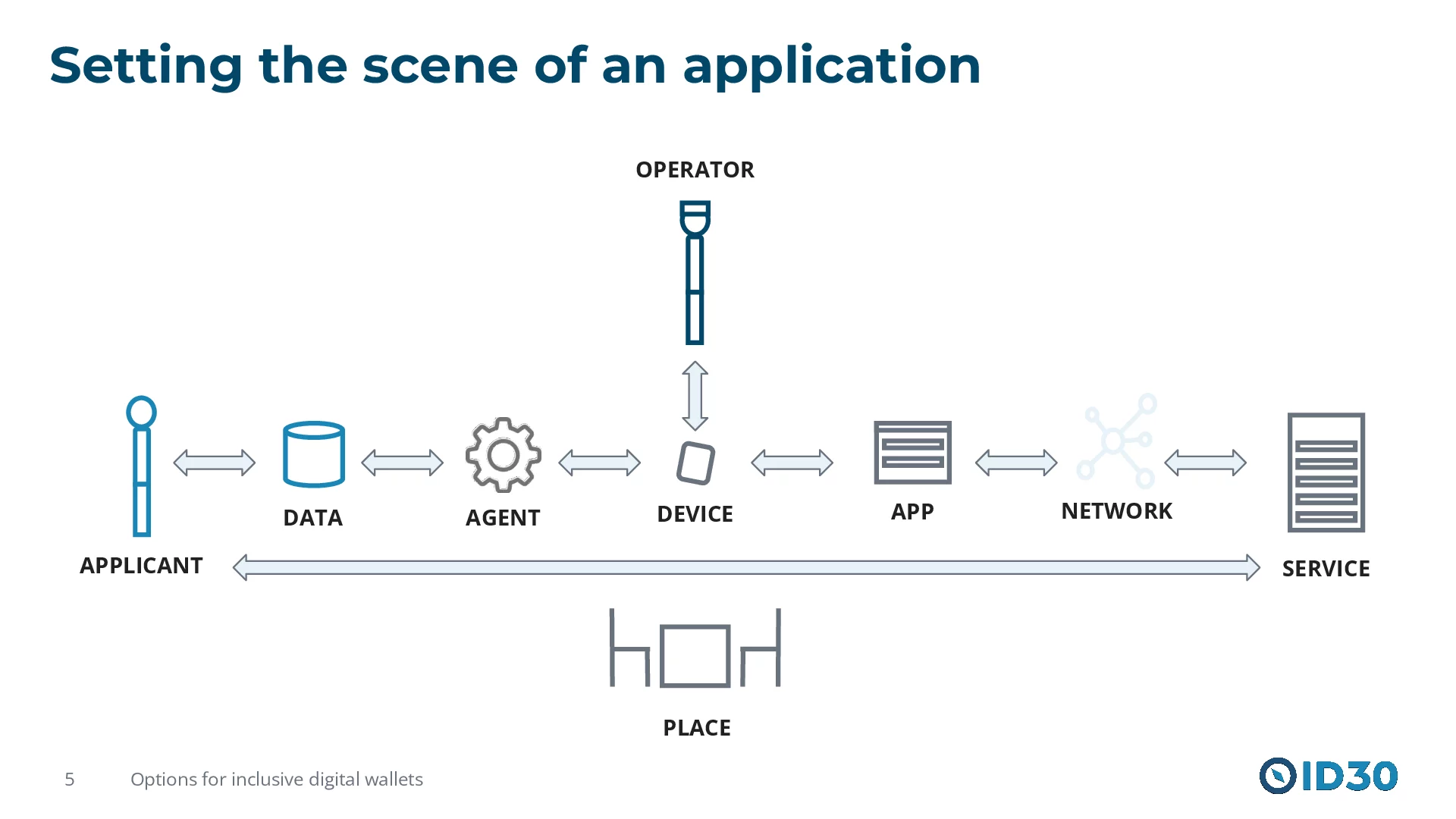
Setting the scene of an application
OPERATOR
NETWORK
DATA
AGENT
DEVICE
APP
APPLICANT
SERVICE
PLACE
-
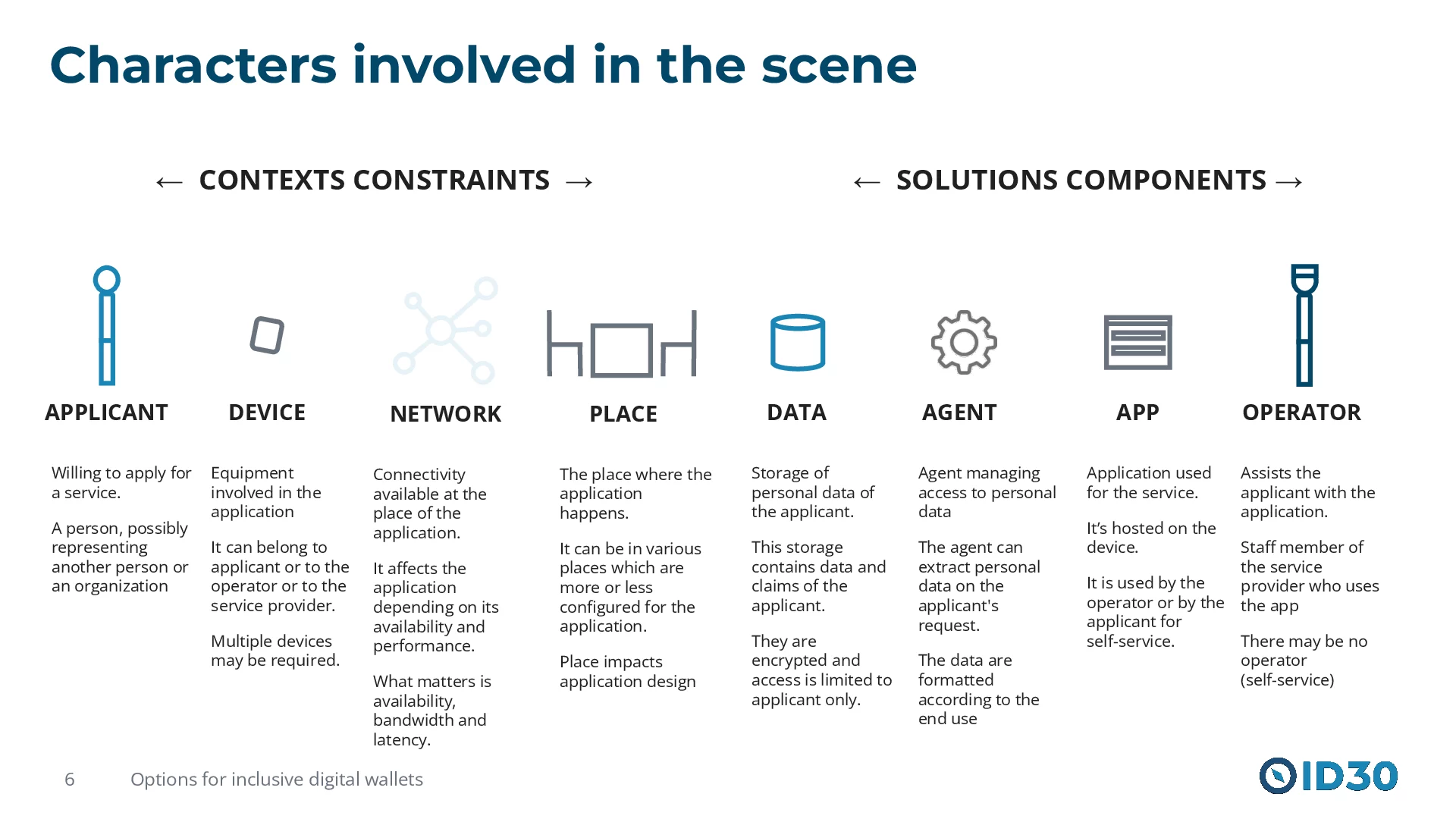
Characters involved in the scene
← CONTEXTS CONSTRAINTS →
← SOLUTIONS COMPONENTS →
APPLICANT
DEVICE
NETWORK
PLACE
DATA
AGENT
APP
OPERATOR
Willing to apply for a service.
A person, possibly representing another person or an organization
Equipment involved in the application
It can belong to applicant or to the operator or to the service provider.
Multiple devices may be required.
Connectivity available at the place of the application.
It affects the application depending on its availability and performance.
What matters is availability, bandwidth and latency.
The place where the application happens.
It can be in various places which are more or less configured for the application.
Place impacts application design
Storage of personal data of the applicant.
This storage contains data and claims of the applicant.
They are encrypted and access is limited to applicant only.
Agent managing access to personal data
The agent can extract personal data on the applicant's request.
The data are formatted according to the end use
Application used for the service.
It’s hosted on the device.
It is used by the operator or by the applicant for self-service.
Assists the applicant with the application.
Staff member of the service provider who uses the app
There may be no operator (self-service)
-
THE DIFFERENT SITUATIONS
Contexts, constraints and solutions components
-
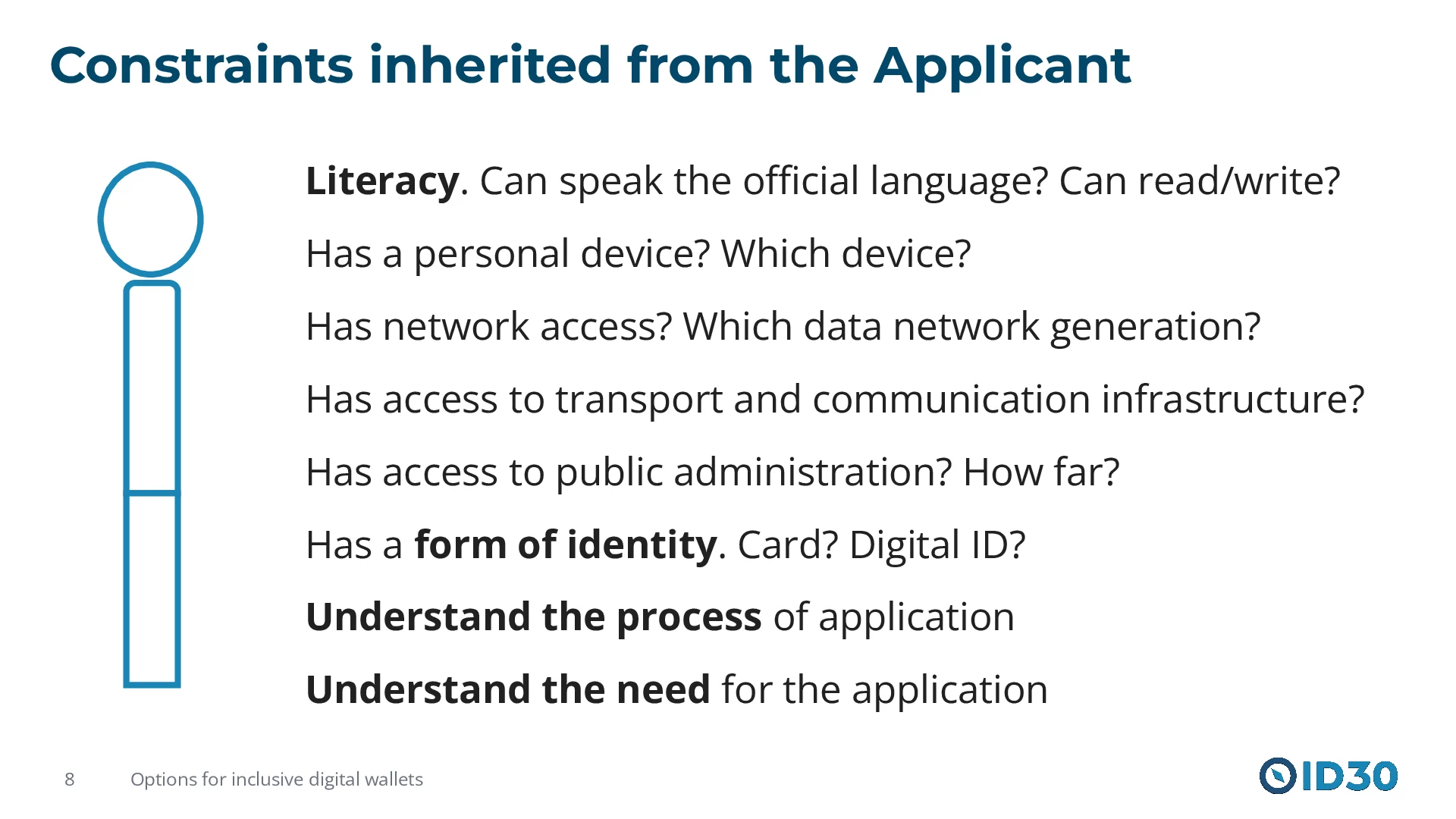
Constraints inherited from the Applicant
Literacy. Can speak the official language? Can read/write?
Has a personal device? Which device?
Has network access? Which data network generation?
Has access to transport and communication infrastructure?
Has access to public administration? How far?
Has a form of identity. Card? Digital ID?
Understand the process of application
Understand the need for the application
-
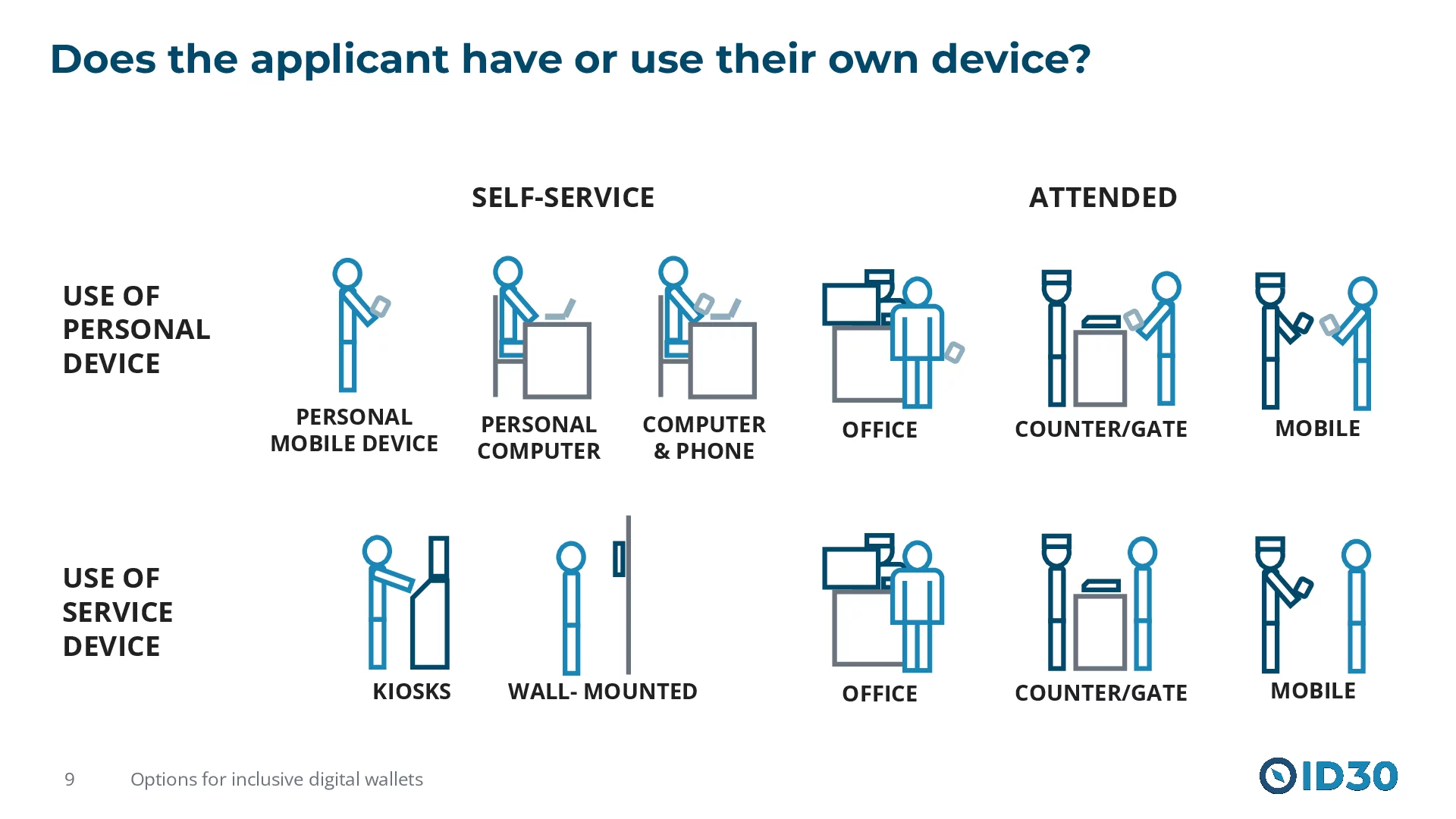
Does the applicant have or use their own device?
SELF-SERVICE
ATTENDED
USE OF PERSONAL DEVICE
PERSONAL
MOBILE DEVICE
PERSONAL COMPUTER
COMPUTER
& PHONE
OFFICE
COUNTER/GATE
MOBILE
USE OF SERVICE
DEVICE
KIOSKS
WALL- MOUNTED
MOBILE
OFFICE
COUNTER/GATE
-
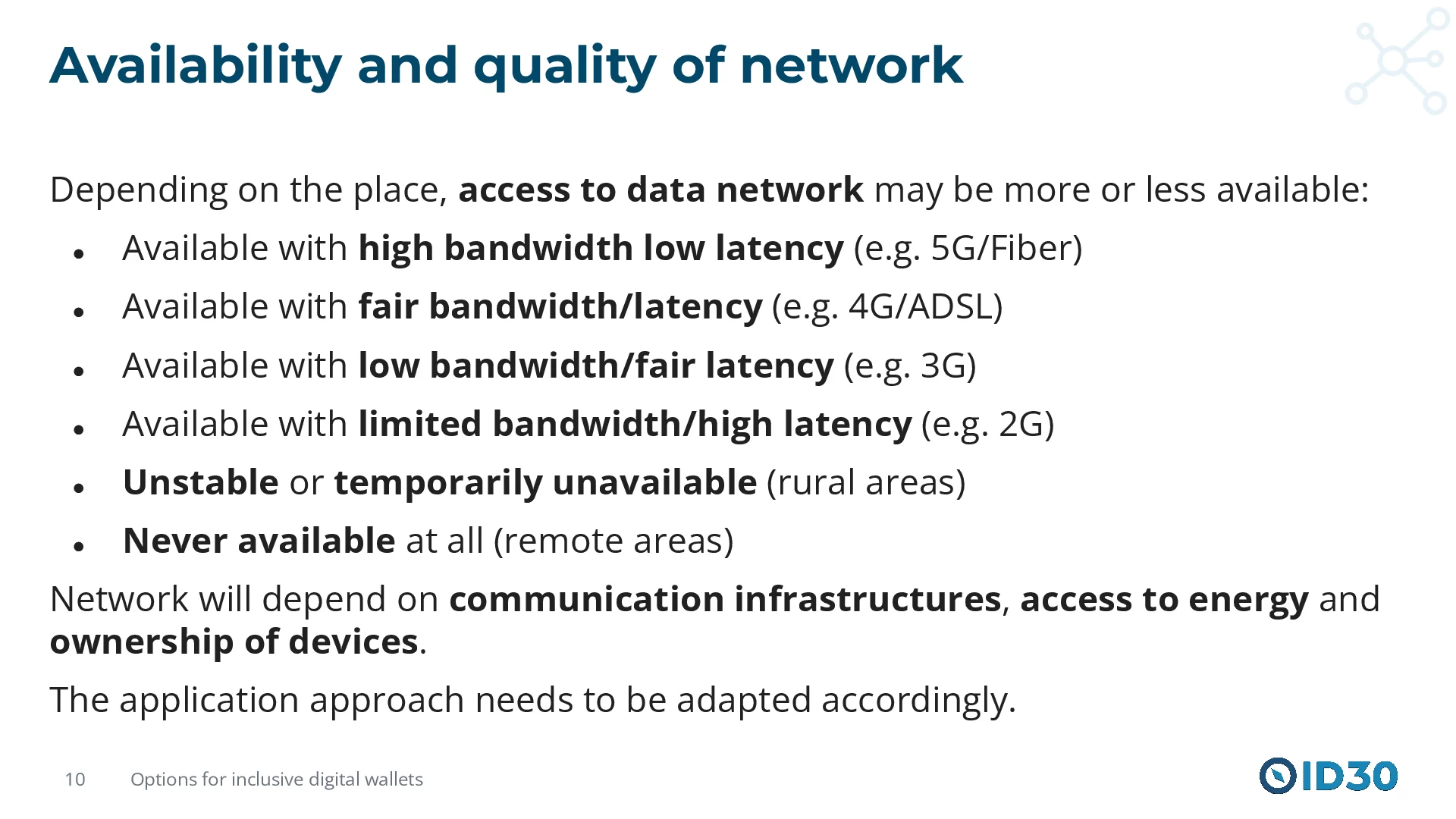
Availability and quality of network
Depending on the place, access to data network may be more or less available:
Network will depend on communication infrastructures, accessto energyand ownership of devices.
The application approach needs to be adapted accordingly.
-
Specific case of offline or lowline
Offline or lowline contexts are generally due to technical barriers such as access to infrastructures, access to devices, unstable resources.
Without connectivity or devices in the applicant's hands, services need to be delivered locally and using what people have and can use.
For example, if they have no device, it would be possible to deliver them a secured token (card with chip or secured USB stick) so they can keeptheir data with them.
Ultimately, to save costs, data could be printed on a card together with a digital signature attesting their authenticity.
-
USE CASES
-
OPTIONS
How to combine solution components
to address the different situations
-
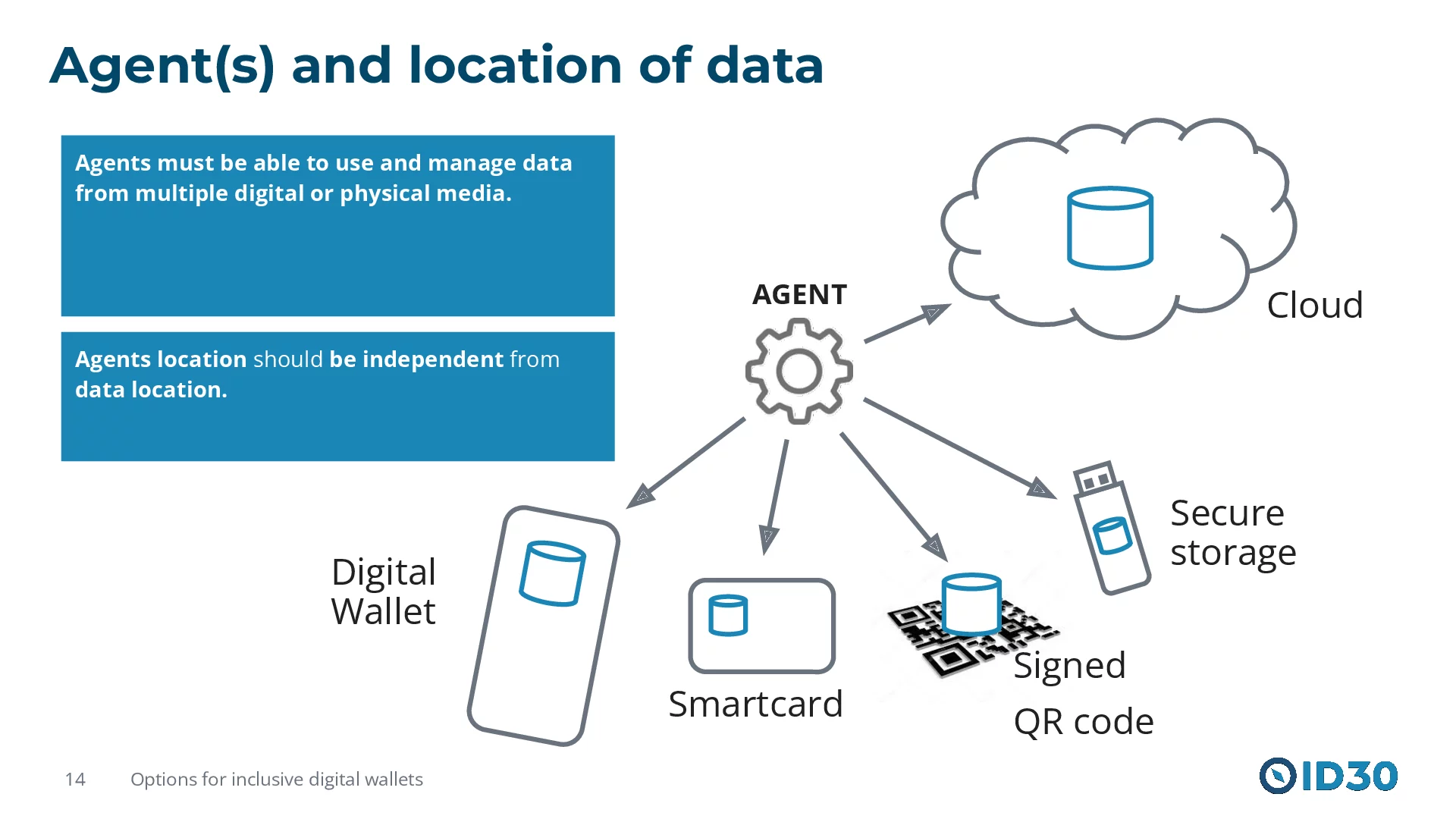
Agent(s) and location of data
Agents must be able to use and manage data from multiple digital or physical media.
AGENT
Cloud
Agents location shouldbe independent fromdata location.
Secure storage
Digital Wallet
Signed
QR code
Smartcard
-
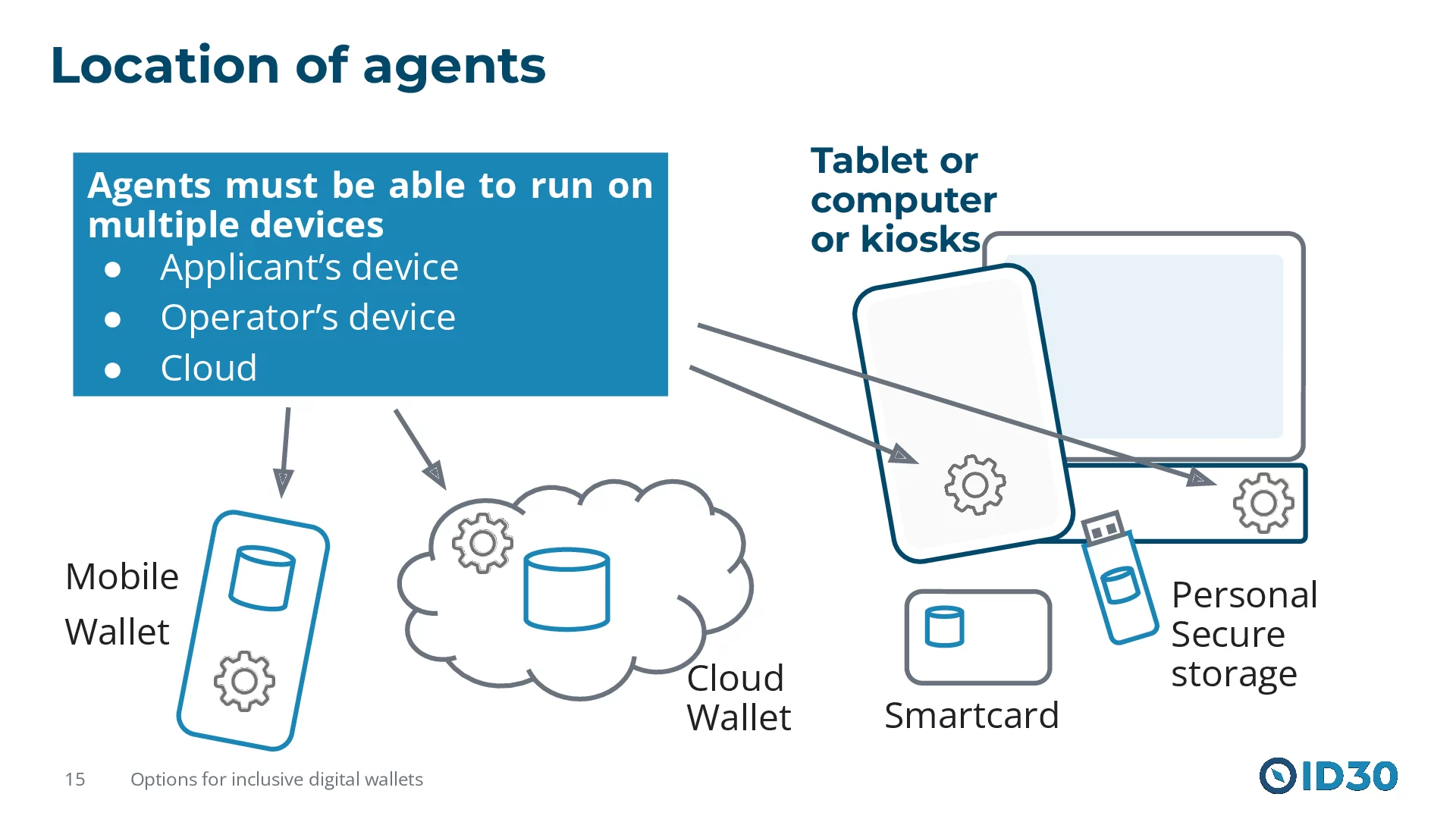
Location of agents
Tablet or computer or kiosks
Agents must be able to run on multiple devices
Mobile
Wallet
Personal Secure storage
Cloud Wallet
Smartcard
-
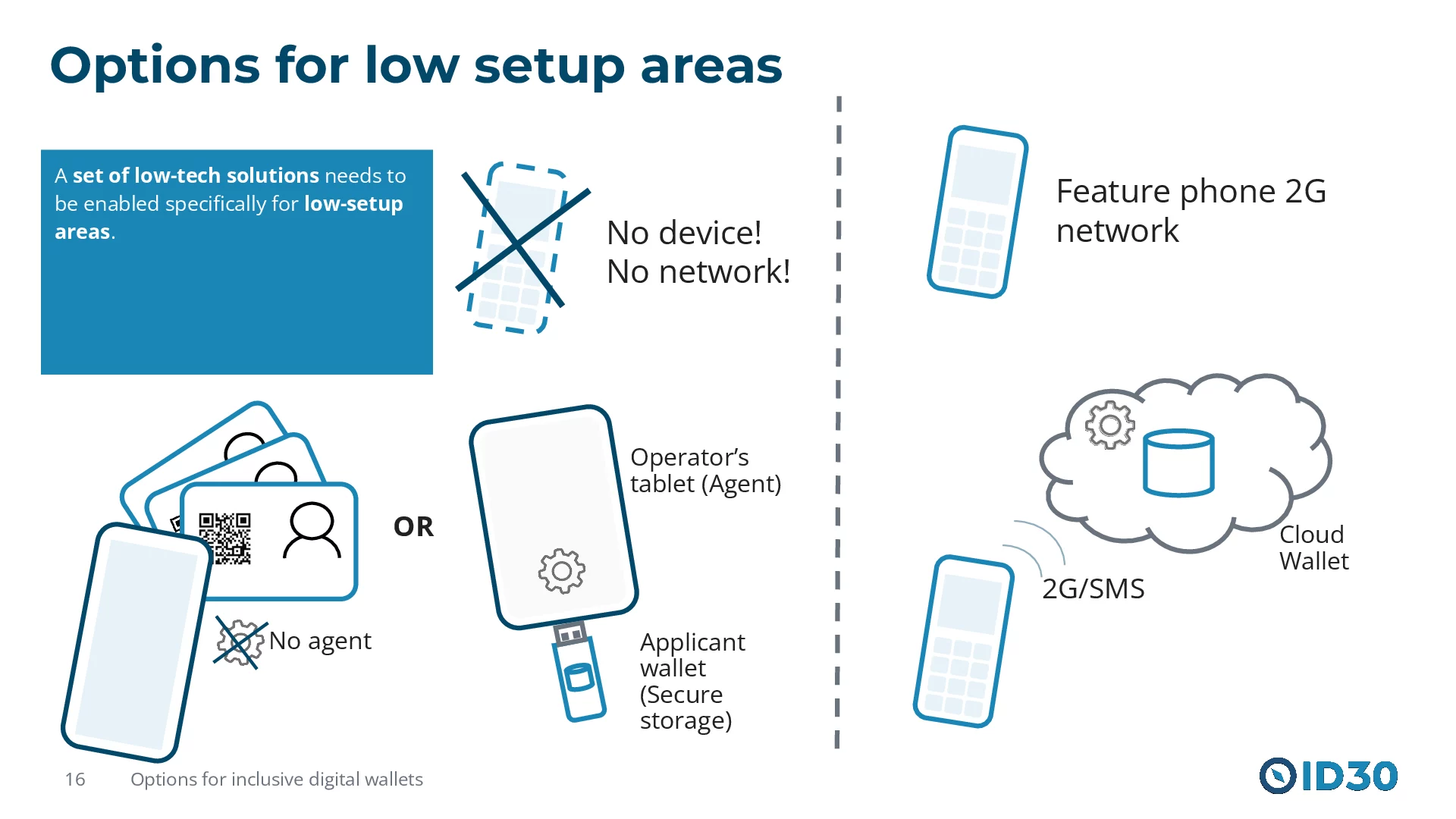
Options for low setup areas
A set of low-tech solutions needs to be enabled specifically for low-setup areas.
Feature phone 2G network
No device!
No network!
Operator’s tablet (Agent)
OR
Cloud Wallet
2G/SMS
No agent
Applicant wallet (Secure storage)
-
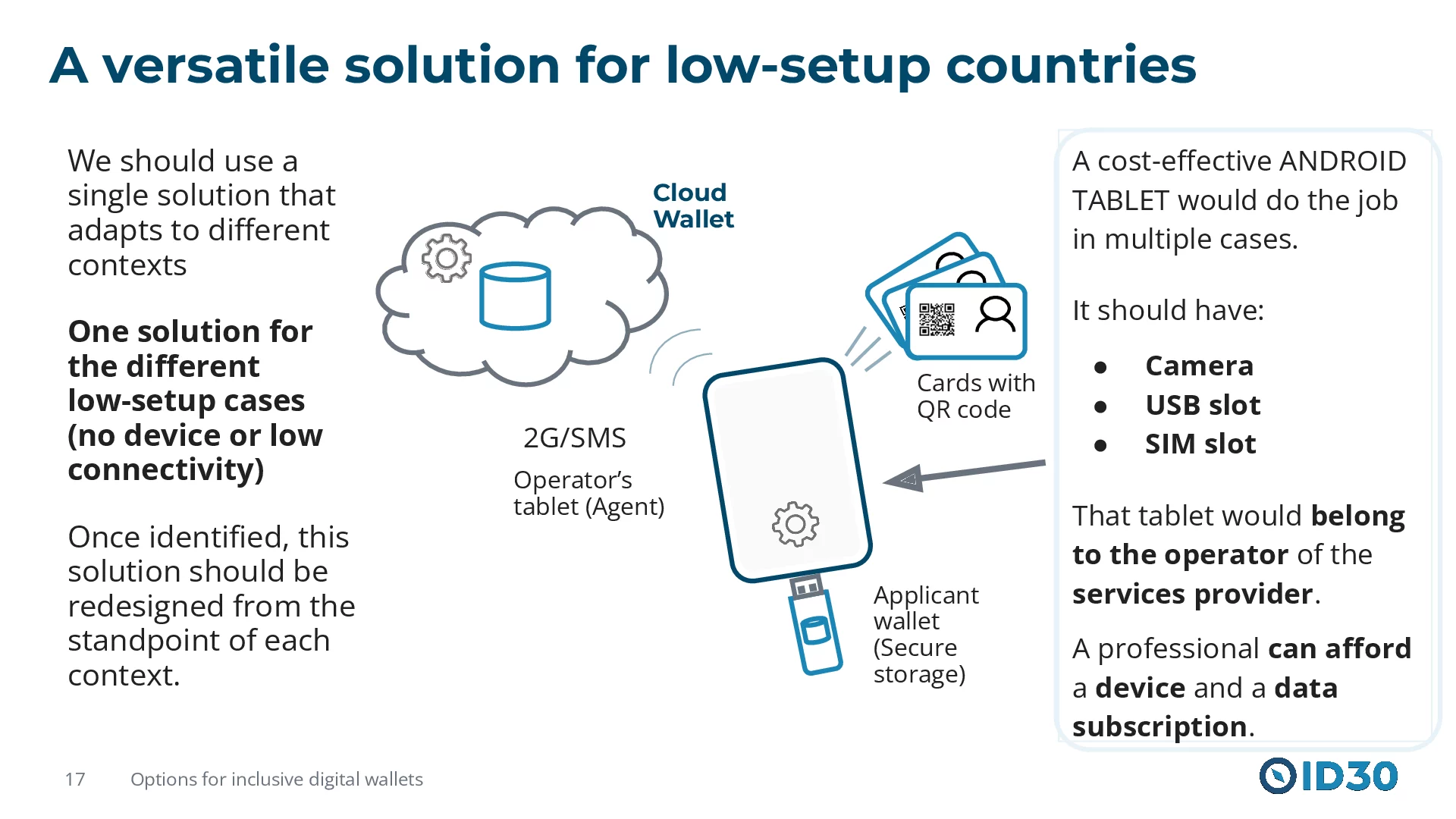
A versatile solution for low-setup countries
We should use a single solution that adapts to different contexts
One solution for the different low-setup cases (no device or low connectivity)
Once identified, this solution should be redesigned from the standpoint of each context.
A cost-effective ANDROID TABLET would do the job in multiple cases.
It should have:
That tablet would belong to the operator of the services provider.
A professional can afford a deviceand a data subscription.
Cloud Wallet
Cards with QR code
2G/SMS
Operator’s tablet (Agent)
Applicant wallet (Secure storage)
-
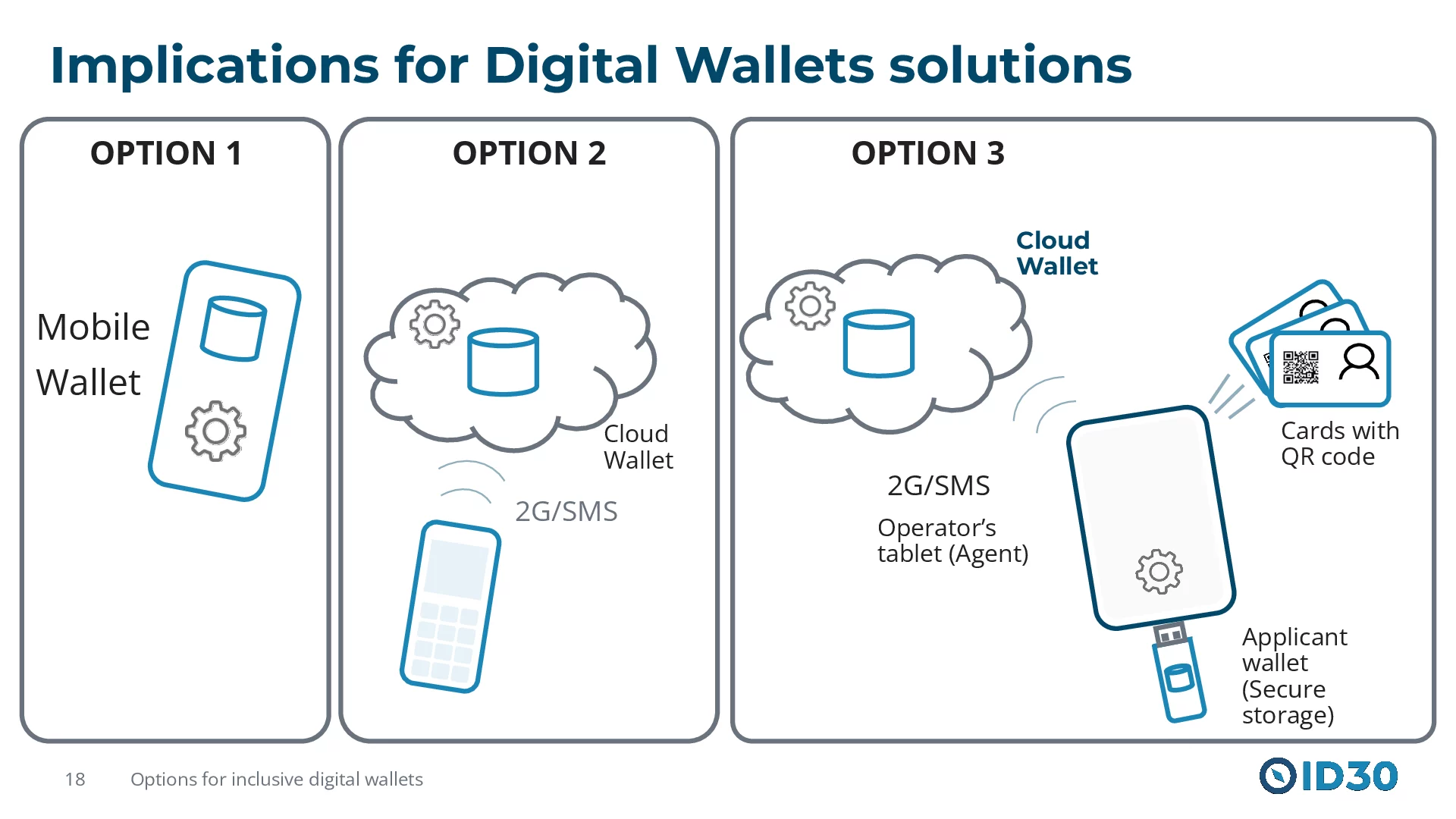
Implications for Digital Wallets solutions
OPTION 1
OPTION 2
OPTION 3
Cloud Wallet
Mobile
Wallet
Cloud Wallet
Cards with QR code
2G/SMS
2G/SMS
Operator’s tablet (Agent)
Applicant wallet (Secure storage)
-
Call to action
If you have reached this slide
... and if you are willing to contribute to at least one element of this solution
... and if you would like to make it happen
Please let us know: contact@id30.org
Deck on Google Slides: Options for inclusive digital wallets
Thanks to MOSIP, the DHI team and the OpenWallet Foundation for their time and insights.
To receive a file copy or arrange a live presentation, contact us.